
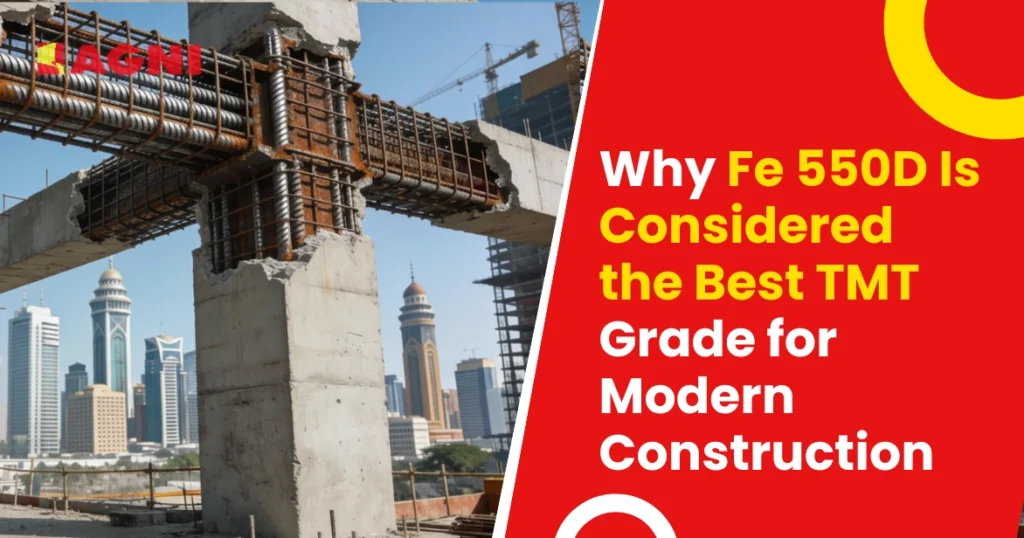
Did you know that, currently, approximately 65% of India’s steel output is used for construction? Therefore, selecting the right TMT grade has a significant impact on the safety and efficiency of modern construction in India. The Fe 550D TMT Bars are ideal for all types of high-rise buildings, including those in seismic zones, due to their superior ductility and strength. Scroll down to explore the specifications of the Fe 550D and know why it is better than other modern construction materials.
What Is Fe 550D? Understanding the Grade & Its Specifications
Fe 550D is a type of iron TMT bar that has a yield strength of at least 550 N/mm². The grade ‘D’ in ‘Fe 550D’ stands for improved ductility according to the IS 1786:2008 standard. Additionally, the TMT bars meet the BIS requirements for chemical composition, which allow for a maximum of 0.25% carbon, 0.040% sulphur, and 0.040% phosphorus.
Fe 550 vs Fe 550D: Which Is Better?
Fe 550D is better than Fe 550 for most buildings. Both have the same 550 N/mm² minimum yield strength, but Fe 550D must reach 14.5% elongation instead of 10%, has a higher minimum tensile strength (600 vs 585 N/mm²) and lower carbon, sulphur and phosphorus limits. That extra ductility matters in earthquake zones and for multi-storey frames.
| Property (IS 1786) | Fe 550 | Fe 550D |
|---|---|---|
| Minimum yield strength | 550 N/mm² | 550 N/mm² |
| Minimum tensile strength | 585 N/mm² | 600 N/mm² |
| Minimum elongation | 10% | 14.5% |
| Carbon, max | 0.30% | 0.25% |
| Sulphur / phosphorus, max | 0.055% / 0.050% | 0.040% / 0.040% |
| Best for | General heavy-load work | Seismic zones, multi-storey and heavy structures |
550D TMT Bars in Tamil Nadu: Choosing the Right Steel for Your Project
Choosing the right TMT bar grade is an important step in building durable residential, commercial and industrial structures. For projects across Tamil Nadu, Fe 550D TMT bars may be suitable where high yield strength and improved ductility are required, subject to the structural design and applicable standards.
Whether you are planning a house, apartment, commercial building or industrial facility, evaluate TMT bars based on their certified mechanical properties, applicable BIS requirements, dimensions and suitability for your project’s structural design.
When sourcing 550D TMT bars in Tamil Nadu, consider these factors:
- Quality and certification: Verify the applicable BIS licence and product markings before purchasing.
- Strength and ductility: Confirm that the grade meets the requirements specified by your structural engineer.
- Reliable supply: Check product availability, delivery coverage and required bar sizes for your project location.
- Technical documentation: Request relevant test certificates and product specifications from the supplier.
Agni Steels manufactures steel products for construction applications. Contact the team to discuss your TMT bar requirements, product specifications and availability for your project in Tamil Nadu.
High-Yield Strength: The Core Advantage of Fe 550D
Fe 550D TMT bars offer 550 N/mm² yield strength, surpassing Fe 500’s 500 N/mm². Fe 550D also has a minimum tensile strength of 600 N/mm², making it suitable for supporting large amounts of weight in modern construction, including buildings such as skyscrapers.
Superior Ductility: Why the ‘D’ in Fe 550D Is Crucial
Fe 550D offers greater ductility than Fe 550, with at least 14.5% elongation (IS 1786) without breaking, while Fe 550 allows only 10% elongation. The high TMT bar ductility will enable them to absorb seismic energy during an earthquake and is therefore ideal for high-rise structures and earthquake-prone regions of India.
Enhanced Earthquake Resistance for Safe Structures
Fe 550D TMT bars provide additional ductility, helping absorb seismic energy. At maximum load, the steel must elongate by 5% before failure. Essentially, in areas with seismic activity, like Gujarat, TMT bars bend rather than break.
High Load-Bearing Capacity for High-Rise & Large Projects
Fe 550D has a 10% higher minimum yield strength than Fe 500, which suits tall buildings. This can reduce the quantity of steel needed, depending on the structural design. Therefore, Fe 550D is widely used for large-scale, heavy-duty projects.
Better Bendability & Flexibility for Complex RCC Designs
Fe 550D has been successfully tested for the mandrel bend test required for sizes 20 mm or less. The rebend test has verified that the bars did not develop any cracks during the ageing process. As a result of the increased ductility of TMT bars such as Fe 550D, complex-shaped details can be created using Reinforced Cement Concrete (RCC) systems.
Corrosion Resistance: Long-Term Protection in Coastal & Humid Areas
The Fe 550D has a maximum sulphur/phosphorus content of 0.040%; this helps prevent rusting. Hence, the structure lasts longer in humid/coastal environments than other bar grades used in the same environments.
Compliance With BIS Standards for Safety & Quality
The mechanical properties of the Fe 550D TMT Bar conform to IS 1786:2008. All certified bars satisfy the specifications for yield strength, tensile strength, and percentage elongation, thereby ensuring the highest quality in all types of materials used in modern construction.
Advantages of Fe 550D Over Fe 500, Fe 500D & Fe 600
Fe 550D has a higher minimum yield strength than Fe 500 and Fe 500D (550 vs 500 N/mm²) and much better elongation than Fe 600 (14.5% vs 10%). Fe 600 is stronger but less ductile, so Fe 550D is often chosen as the balance of strength and ductility for seismic and multi-storey work.
Applications of Fe 550D in Modern Construction
- Residential Properties- Higher TMT bar ductility to build safe multi-storey homes
- Commercial Structures- Higher load capacity for malls
- High-rise Towers- Higher strength can reduce steel quantity
- Bridges and Flyovers -Better bendability in spans
- Industrial Projects- Corrosion Resistance
Why Do Architects & Engineers Prefer Fe 550D Today?
Architects prefer working with Fe 550D for its ability to meet both seismic regulations and flexibility at an economical price point. The increased strength of Fe 550D can reduce the amount of steel required, depending on the design, thus resulting in lower crane loads, reduced labour costs, and more long-term savings. Additionally, the use of Fe 550D enables the construction of multi-storey buildings in earthquake-prone regions and provides corrosion resistance when used in coastal areas.
The combination of these applications has fuelled rapid growth in demand for TMT bars across India. Furthermore, the TMT bars’ ductility enables designers and builders to create innovative, long-lasting structures.
Frequently Asked Questions
Fe 550 vs Fe 550D: which is better?
Fe 550D is better for most buildings. Both have 550 N/mm² minimum yield strength, but Fe 550D needs 14.5% elongation instead of 10%, 600 instead of 585 N/mm² tensile strength, and lower sulphur and phosphorus limits under IS 1786.
What does Fe 550D mean?
Fe 550D is an IS 1786 TMT bar grade: Fe is iron (steel), 550 is the minimum yield strength in N/mm², and D means higher ductility.
What is the minimum elongation of Fe 550D?
At least 14.5% under IS 1786, compared with 10% for Fe 550.
Final Thoughts
Fe 550D TMT bars are leading among modern construction materials in India, with an unmatched strength-ductility balance. If you are an architect or looking to select a quality construction material for your residential or industrial project, look no further than Fe 550D TMT bars. It’s perfect for India’s seismic, high-rise needs.
More Guides on Fe 550D and TMT Grades
- 550D TMT Bar Wholesale Suppliers in Tamil Nadu: What Buyers Should Know
- 550 Grade TMT Bars: Complete Guide to Strength, Benefits and Applications
- How We Deliver Premium 550 Grade TMT Bars in Chennai
- High Tensile Steel Bars: Strength, Safety & Performance for Modern Construction | Agni Steels
- Best fe 500d TMT bars for construction
- What factors determine the different Grades of Steel!
- Bending Boundaries: Design Versatility with TMT Bar’s Superior Elongation
- Beyond Strength: Secret to Effortless Brilliance in Construction with High Ductile Steel TMT Bars
- Top Reasons 550D TMT Steel Rods Ensure Long-Lasting Structures
- 550d steel bars suppliers in Karnataka
- How XLS D TMT Bars Ensure Safety and Longevity in Structure
- Why FE550 and FE550D are the most preferred TMT Bars?
- Unveiling the Superiority of Fe-550D TMT Bars in High-Rise Construction Projects
- Building Success: Wholesale Advantage of 550D TMT Bars in Construction
- Building Tall, Building Strong: Advantages of 550D TMT Bars in High-Rise Projects
- Decoding the Impact of 600 TMT Rods in Earthquake-Resistant Construction
- The Rise of 550 Grade TMT Bars in Tamil Nadu
- Advantages of 550d Tmt Bars Suppliers in Chennai
- BEST FE 500D TMT BARS FOR CONSTRUCTION
- Best 500d Tmt steel rods
- Best 550d TMT Steel Rods in Construction Projects
- Everything You Need to Know About the Best 550D TMT Bars For Construction
- Choose High-Quality 550D Steel Bars For Your Construction
- 550d TMT bars wholesale suppliers
- Difference Between Fe500 and Fe500D TMT rods
- How to ensure the right quality of Fe 500D TMT bars for your constructions
- How dealers can ensure they are buying the right Fe 500D TMT Rods
- Significance of Ductile Steel in Modern Constructions
Related guides: Where to Buy the Best 550D Grade TMT Bars at Competitive Prices · Comparative Analysis of Grade 550D vs 600 TMT Bars · The Significance of Engineers’ Choice TMT Bars and 550D Grade for Earthquake-Resistant Structures