
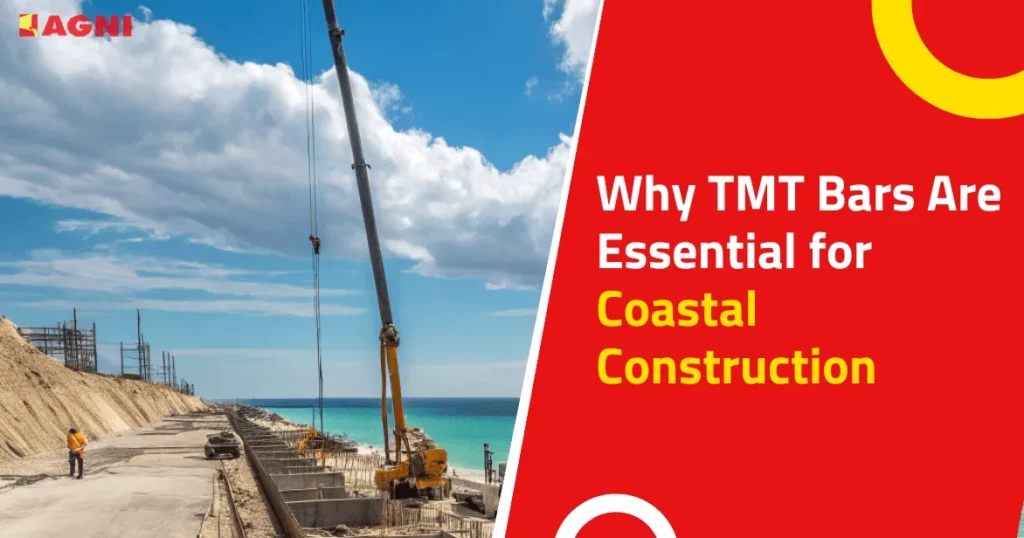
Quick answer: near the sea, use corrosion-resistant (CRS) TMT bars in grade Fe 500D or Fe 550D made to IS 1786, and protect them with dense concrete and enough cover. The bar alone cannot stop rust. The concrete around it does most of that work, so the mix and the cover matter as much as the brand of steel.
Coastal houses have been known to have beautiful views, fresh air and a serene lifestyle, but there are special dangers associated with building within the coastal areas. However, the salty water, the constant moisture, and exposure to high salinity levels can cause a coastal property to undergo structural deterioration unless it is fortified accordingly. This is where the importance of the TMT comes in.
In this blog, we understand coastal constructions and how TMT can help reinforce the structures and give them a longer, more stable life.
What Makes Coastal Environments So Challenging?
Coastal areas are subjected to various environmental problems that are not common in inland areas. The biggest factor is the high salt concentration in the air and soil. Salinity increases the rate of corrosion in metal, reducing the strength of buildings’ cores over time.
All these factors make for a very corrosive environment, and coastal buildings are much more likely to suffer structural fatigue, cracks and even failure when subpar materials are used.
How TMT Bars Protect Against Salt, Wind, and Moisture
The reinforced concrete structures are made up of Thermo-Mechanically Treated (TMT) bars. They are stronger and more ductile and also have greater corrosion resistance, which is particularly important in coastal areas. Bars are made by a special process of heat treatment to create a tough outer layer and a soft inner portion for a flexible and strong bar.
TMT bars with enhanced strength, used especially in regions with severe climate conditions, are also available.
Common Mistakes to Avoid in Coastal Construction
One of the fatal mistakes made by property owners is using cheaper, lower-grade steel bars to reduce the initial cost. This short-term thinking tends to result in a longer-term loss, as corrosion occurs quickly and repairs are frequent. Poor concrete cover and waterproofing, if neglected, may also lead to moisture reaching the internal steel reinforcement.
The builders may also fail to inspect the certification and test reports of the steel bars to be used. Unless quality checks are done, it cannot be assured that the bars will be able to resist the hostile nature of a coastal environment.
How to Choose the Right TMT Bars for Coastal Areas
It is necessary to choose corrosion-proof and earthquake-proof options for construction.
This is what to consider when choosing TMT:
- Corrosion resistance: The bars must be tested and certified for high corrosion resistance.
- Ductility: The bars must be flexible to enable them to withstand the environmental pressure.
- Brand reputation: Select reputable manufacturers like Agni that deliver quality regularly.
- BIS Certification: BIS certification is another factor that should always be considered, i.e., whether the bars are BIS certified and are manufactured as per IS standards.
- Third-party test reports: Request a test report to verify the mechanical and chemical characteristics.
For best results, consult your contractor or construction engineer to find the right grade of TMT with the specifics of your location and design.
Long-Term Benefits of Using Quality TMT Bars
Your coastal property should use bars of the highest quality to make the investment worthwhile. They are more durable, cut down on maintenance costs, and limit the chances of structural collapse. Especially if Agni Fe 550D TMT bars are used, your residence will be prepared to face the corrosive environment and any destructive seismic activity in the region.
Also, these bars bond with concrete better, have increased fire resistance, and reduce the likelihood of cracking under a load. This leads to more secure living conditions and savings in the long run.
Final Thoughts: Build Strong, Build Smart
Coastal constructions, especially a mansion near the sea, are a dream of many people, but to make this dream come true and last safely and long, one has to choose the right material. Structural integrity is something that cannot be compromised in areas where salt-laden winds are common and areas that have high moisture levels, because the consequences of doing so are fatal.
Using high-quality materials from Agni now means a stronger, safer future ahead.
Concrete Cover and Mix for Coastal Sites (IS 456)
IS 456 classes concrete in a coastal environment as “severe” exposure, and concrete hit by sea-water spray as “very severe”. For reinforced concrete it sets these minimums:
| Exposure | Typical location | Minimum concrete grade | Maximum water-cement ratio | Nominal cover |
| Severe | Coastal environment | M30 | 0.45 | 45 mm |
| Very severe | Exposed to sea-water spray | M35 | 0.45 | 50 mm |
| Extreme | Tidal zone | M40 | 0.40 | 75 mm |
Your structural engineer fixes the final values for each member. Treat these as the floor, not the target.
Site Checklist for Coastal Projects
- Store bars on wooden sleepers, off the ground, and cover them. Salt air rusts exposed bundles within weeks.
- Do not use bars with flaky or pitted rust. A thin, even brown film is normal; loose scale is not.
- Use cover blocks of the right size on every bar so the cover in the drawing is the cover you get.
- Never use sea sand or untreated water in the mix. Both add chlorides that attack the steel from inside.
- Cure the concrete properly. Well-cured concrete lets far less salt water reach the bars.
Coastal Construction: Common Questions
Which TMT bars are best for coastal construction?
Corrosion-resistant (CRS) TMT bars in Fe 500D or Fe 550D grade, made to IS 1786 by a manufacturer that tests every batch. Pair them with at least M30 concrete and the cover IS 456 asks for.
Is a higher grade always better near the sea?
Not by itself. Grade is about strength. Corrosion resistance comes from the steel chemistry (CRS bars) and, above all, from good concrete and cover.
Should coastal homes use epoxy-coated bars?
For very aggressive spots such as sea-facing walls or tidal structures, engineers sometimes specify epoxy-coated bars (IS 13620). For most homes, CRS TMT bars with good concrete and cover are enough. Ask your engineer.
Main guide: CRS steel: corrosion-resistant TMT bars
Related guides: India’s steel ministry is betting on coastal shipping to increase efficiency in domestic sector · The Hidden Costs of Using Low-Quality TMT Bars: What You Need to Know · Why the Best Quality TMT Bars Are Essential for Construction