
Introduction
Choosing the right TMT bar is an important part of any construction project. Whether you are building a home, apartment, commercial property, or large infrastructure project, reinforcement steel needs to meet the required technical and quality specifications.
One of the most important things buyers should understand is BIS certification and IS 1786 standards for TMT reinforcement bars.
But what does BIS actually mean? How can you check whether a TMT bar meets the required standard? What should you look for on the bar, bundle tag, and test certificate?
This guide explains the basics of TMT bar BIS standards, IS 1786, quality checks, grades, markings, testing, and how buyers can make a more informed steel purchase.
What Is BIS for TMT Bars?
BIS, or the Bureau of Indian Standards, is India’s national standards body.
For high-strength deformed steel bars and wires used as concrete reinforcement, the relevant Indian Standard is IS 1786. The standard specifies requirements for reinforcement steel, including grades, mechanical properties, chemical composition, dimensions, mass, bending, and other quality parameters.
BIS standards establish consistent technical requirements that manufacturers and testing laboratories can use to produce and evaluate reinforcement steel.
What Is IS 1786?
IS 1786:2008 is the Indian Standard titled High Strength Deformed Steel Bars and Wires for Concrete Reinforcement — Specification.
It covers different grades of reinforcement steel, including:
- Fe 415
- Fe 415D
- Fe 415S
- Fe 500
- Fe 500D
- Fe 500S
- Fe 550
- Fe 550D
- Fe 600
The number associated with the Fe designation relates to the specified minimum yield or proof stress in N/mm², while the D designation indicates enhanced elongation requirements compared with the corresponding non-D grade.
Therefore, Fe 500D and Fe 550D should not be understood simply as different “quality levels.” They are different grades with specified mechanical requirements.
Why Is BIS Compliance Important for TMT Bars?
TMT bars become part of the reinforced concrete structure. Their mechanical and dimensional properties must match the project’s specified requirements.
IS 1786 includes requirements and tests relating to characteristics such as:
- Yield strength
- Tensile strength
- Elongation
- Bend performance
- Chemical composition
- Carbon equivalent
- Nominal dimensions
- Nominal mass
- Surface and rib characteristics
BIS laboratory records for IS 1786 include testing areas such as weight, dimensions, tensile strength, yield stress, elongation, bend tests, chemical composition, and other parameters.
TMT Bar Grades Under IS 1786
Different TMT grades are designed to meet different specified mechanical requirements.
| Grade | General Meaning |
|---|---|
| Fe 415 | Minimum specified yield/proof stress of 415 N/mm² |
| Fe 500 | Minimum specified yield/proof stress of 500 N/mm² |
| Fe 500D | Fe 500 grade with enhanced elongation requirements |
| Fe 550 | Minimum specified yield/proof stress of 550 N/mm² |
| Fe 550D | Fe 550 grade with enhanced elongation requirements |
| Fe 600 | Higher-strength reinforcement grade |
Select the appropriate grade based on the structural design and project specifications, rather than choosing the highest numerical grade.
How to Identify Quality TMT Bars?
Buyers can perform several checks before accepting a TMT steel consignment.
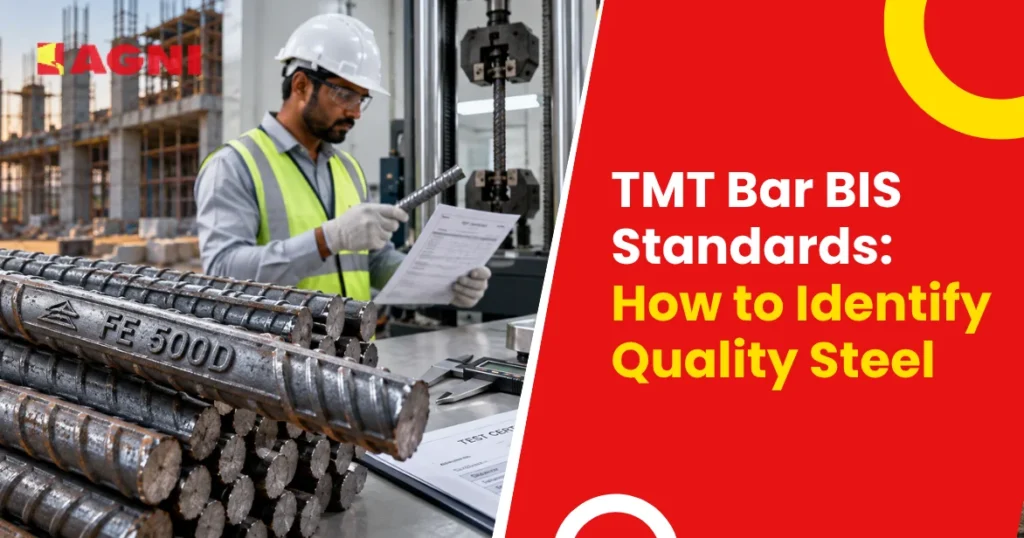
1. Check the Manufacturer’s Marking
TMT bars should have identifiable markings or branding introduced during rolling.
BIS documentation for IS 1786 also specifies identification and marking requirements intended to allow finished bars to be traced back to their cast.
Look for:
- Manufacturer or brand identification
- Grade
- Size
- Relevant identification marks
Do not rely only on the appearance of the ribs or the colour of the bar.
2. Check the Bundle Tag
A TMT bundle should have appropriate identification information.
BIS documentation specifies that bundles/coils should carry information such as the cast or lot number, grade, and size to support traceability.
Before accepting material, compare the bundle information with the purchase order and delivery documents.
3. Verify the Grade
Make sure the supplied grade matches the grade specified for your project.
For example, if the structural specification requires Fe 500D, identify the delivered material accordingly.
Do not assume that a higher number automatically means the product is suitable for your structure.
4. Check the Test Certificate
A test certificate provides important technical information about the supplied steel.
Depending on the applicable certification and supply documentation, buyers may find details such as:
- Manufacturer
- Grade
- Size
- Cast or lot number
- Test results
- Applicable standard
- Certification information
The certificate should correspond to the actual material supplied.
5. Check the Weight
TMT bars have theoretical weights based on their nominal diameter.
The commonly used formula is:
Weight per metre = D² ÷ 162
Where D is the nominal diameter in millimetres.
For example, for a 12 mm bar:
12² ÷ 162 = 0.888 kg/m
So the theoretical weight of a 12 mm TMT bar is approximately 0.888 kg per metre.
Actual mass can vary within applicable tolerances, so theoretical weight should not be treated as the exact commercial weight of every individual bar.
6. Check the Surface and Ribs
TMT bars are deformed bars with ribs designed to improve mechanical interlock with concrete.
IS 1786 includes requirements relating to deformation and surface characteristics.
When inspecting material, look for:
- Consistent rib pattern
- No obvious abnormal surface damage
- No excessive scaling or defects
- Consistent bar dimensions
Visual inspection is useful, but it cannot replace proper testing and certification.
7. Check Bend Performance
Bend and rebend tests are among the quality parameters considered under IS 1786.
These tests evaluate how the reinforcement behaves under specified bending conditions. BIS laboratory scopes for IS 1786 include bend and rebend testing.
However, buyers should not attempt informal destructive testing at the construction site as a substitute for laboratory testing.
What Does Fe 500D Mean?
The Fe designation is followed by a number indicating the specified minimum yield/proof stress.
For example:
Fe 500 → 500 N/mm² minimum specified yield/proof stress
The D in Fe 500D indicates enhanced specified elongation requirements compared with Fe 500.
Similarly:
Fe 550D → 550 N/mm² minimum specified yield/proof stress with enhanced elongation requirements.
IS 1786 defines these requirements.
BIS Mark vs IS Standard: What’s the Difference?
These terms are sometimes used interchangeably, but they are not exactly the same.
IS 1786 is the Indian Standard that specifies technical requirements for high-strength deformed steel bars and wires used for concrete reinforcement.
BIS certification/licensing relates to conformity with the applicable Indian Standard under BIS’s certification framework.
Therefore, when purchasing TMT steel, buyers should look beyond a simple claim such as “ISI quality” and verify the relevant certification and product documentation.
Important TMT Quality Parameters
A quality evaluation can involve multiple technical parameters.
| Parameter | Why It Matters |
|---|---|
| Yield strength | Indicates resistance to yielding |
| Tensile strength | Indicates resistance under tensile loading |
| Elongation | Indicates ductility characteristics |
| Chemical composition | Helps ensure specified material chemistry |
| Carbon equivalent | Relevant to weldability considerations |
| Nominal mass | Helps evaluate material quantity |
| Dimensions | Ensures conformity with specified size |
| Rib/deformation characteristics | Supports bond with concrete |
| Bend/rebend performance | Evaluates behaviour under specified bending conditions |
IS 1786 specifies requirements and tests for these characteristics.
Common Mistakes When Buying TMT Bars
Mistake 1: Choosing Only Based on Price
The cheapest available steel is not necessarily the appropriate product for a particular structural specification.
Compare the required grade, technical specifications, certification, quantity, and applicable commercial terms.
Mistake 2: Assuming More Weight Means Better Quality
A heavier bar is not automatically a better bar.
The nominal diameter, permitted tolerances, grade, mechanical properties, and applicable standard should all be considered.
Mistake 3: Selecting a Grade Without Engineering Advice
Do not select Fe 500D or Fe 550D solely because the grade number is higher.
The structural engineer should specify the appropriate grade based on the design.
Mistake 4: Ignoring Documentation
A visual inspection alone cannot establish all the mechanical and chemical properties of steel.
Check relevant test certificates and traceability information.
Mistake 5: Buying Without Checking the Brand Marking
Always verify the manufacturer or brand identification and compare it with the purchase documents.
TMT Bar Quality Checklist for Buyers
Before accepting a TMT steel delivery, check:
- Manufacturer/brand identification
- TMT bar diameter
- Required steel grade
- BIS certification details where applicable
- IS 1786 compliance information
- Bundle/cast/lot identification
- Test certificate
- Nominal mass/weight information
- Surface and rib condition
- Quantity supplied
- Delivery documentation
This simple checklist can help contractors, builders, engineers, and homeowners maintain better control over steel procurement.
Why Choose a Reliable TMT Steel Manufacturer?
The quality of reinforcement steel depends on more than the brand name printed on the product. Manufacturing controls, testing, traceability, certification, consistency, and supply practices are all important.
Agni Steels manufactures TMT steel products for construction requirements. When evaluating TMT steel, buyers should compare the required grade, applicable standards, product specifications, test documentation, and project requirements before purchase.
Frequently Asked Questions
What BIS standard is used for TMT bars?
High-strength deformed steel bars and wires for concrete reinforcement are covered by IS 1786:2008.
What is IS 1786?
IS 1786 is the Indian Standard for high-strength deformed steel bars and wires used for concrete reinforcement.
How can I check TMT bar quality?
Check the manufacturer’s identification, grade, size, bundle/lot information, applicable certification, test certificate, weight, dimensions, and relevant technical specifications.
What does Fe 500D mean?
Fe 500D is a reinforcement steel grade with a specified minimum yield/proof stress of 500 N/mm² and enhanced specified elongation requirements compared with Fe 500.
Is TMT bar weight an indication of quality?
Weight alone does not determine steel quality. Diameter, permitted mass variation, mechanical properties, chemical composition, certification, and applicable standards should also be considered.
Should I choose the Fe 500D or Fe 550D?
The appropriate grade depends on the structural design and project requirements. Select the grade based on the engineer’s specifications rather than simply choosing the higher number.
Conclusion
Understanding TMT bar BIS standards can help buyers make better-informed decisions when purchasing reinforcement steel.
IS 1786 establishes important requirements for high-strength deformed steel reinforcement, including grades, mechanical properties, chemical composition, dimensions, mass, deformation characteristics, and testing.
When buying TMT bars, don’t evaluate steel based only on price or appearance. Check the manufacturer marking, grade, size, bundle identification, test certificate, applicable BIS certification, weight, and technical specifications.
For construction projects, always follow the structural engineer’s specifications and use reinforcement steel that meets the applicable requirements.
Agni Steels provides TMT steel solutions for construction applications, selecting products based on project requirements.