
Introduction
When choosing TMT bars for construction, strength is one of the first properties engineers and builders consider. However, elongation of steel is equally important because it indicates how much a steel bar can deform before it breaks.
A TMT bar with suitable elongation can absorb deformation and provide better ductility to reinforced concrete structures. This is particularly important when structures are exposed to heavy loads, vibrations, temperature changes or sudden stresses.
In simple terms, elongation measures the ability of steel to stretch under tensile force before fracture.
For TMT bars, understanding elongation helps engineers and construction professionals evaluate the balance between strength and ductility.
What Is Elongation of Steel?
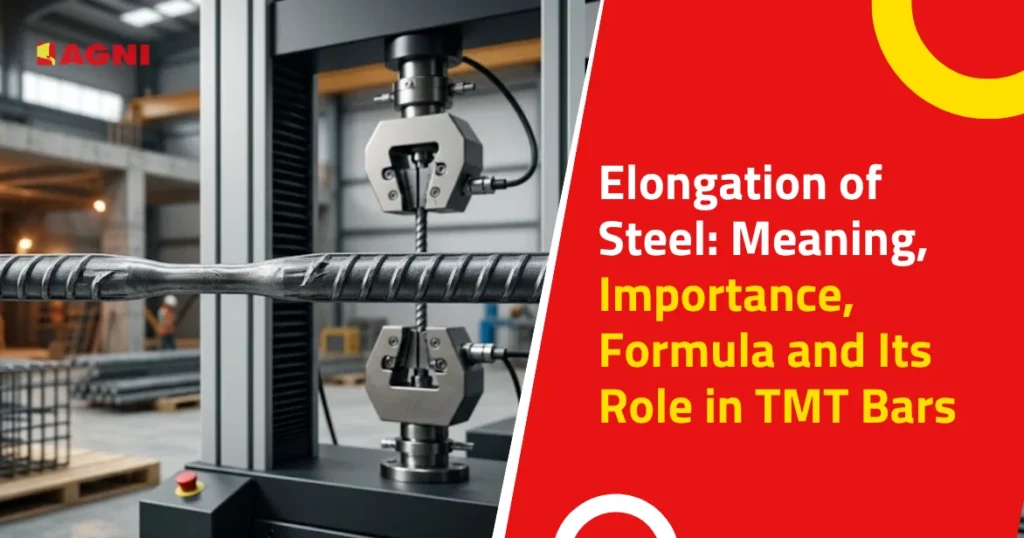
Elongation of steel is the percentage increase in the original length of a steel specimen after it has been subjected to a tensile test and fractured.
It is generally expressed as a percentage (%).
For example, if a test specimen initially measures 100 mm and its measured gauge length after fracture is 120 mm, the elongation is:
Elongation = [(Final Length − Original Length) / Original Length] × 100
Therefore:
Elongation = [(120 − 100) / 100] × 100 = 20%
This means the steel specimen experienced a 20% increase in length before fracture, based on the specified test measurement.
Why Is Elongation Important in Steel?
Steel structures and reinforced concrete members do not always experience perfectly static loads. Buildings can be subjected to wind, vibrations, impact, temperature changes and, in some regions, seismic forces.
Elongation is important because it is closely associated with ductility.
A ductile steel can undergo significant deformation before failure. This gives a structure the ability to deform and redistribute stresses rather than experiencing sudden brittle failure.
For reinforcement steel, appropriate elongation can therefore contribute to structural performance and safety.
Elongation vs Strength of Steel
Strength and elongation are two different properties.
Strength indicates how much stress the steel can withstand before yielding or breaking.
Elongation indicates how much the steel can deform before fracture.
A useful way to understand this is:
- Higher strength: Steel can withstand greater stress.
- Higher elongation: Steel can undergo greater deformation before fracture.
- Ductility: Describes the ability of steel to deform plastically without sudden failure.
The ideal reinforcement steel needs an appropriate balance between strength and ductility according to the applicable standard and structural requirements.
How Is Elongation of Steel Calculated?
The basic elongation formula is:
Percentage Elongation = [(Lf − L0) / L0] × 100
Where:
L0 = Original gauge length
Lf = Final gauge length after fracture
Example
Suppose a steel test specimen has:
Original gauge length = 200 mm
Final gauge length = 240 mm
Then:
Percentage Elongation = [(240 − 200) / 200] × 100 = 20%
Therefore, the measured elongation is 20%.
Actual testing and reporting must follow the relevant testing standard and prescribed specimen dimensions.
How Is Elongation Tested?
Elongation is generally determined through a tensile test.
During the test, a steel specimen is placed in a testing machine and subjected to increasing tensile force until it fractures.
The test helps determine several mechanical properties, including:
- Yield strength
- Tensile strength
- Elongation
- Stress-strain behaviour
After fracture, the relevant gauge length is measured according to the applicable testing procedure. The increase in length is then used to calculate the percentage elongation.
What Does Elongation Tell Us About TMT Bars?
For TMT reinforcement bars, elongation provides an indication of their ability to undergo deformation under tensile loading.
This is particularly important because reinforcement steel works together with concrete. When a reinforced concrete member experiences stress, the steel reinforcement may need to deform while continuing to carry tensile forces.
Appropriate ductility helps reinforcement accommodate such deformation.
This is one reason why TMT bar selection should not be based only on the highest strength value.
Why Is Elongation Important in Earthquake-Resistant Construction?
Ductility becomes especially important when structures experience cyclic or dynamic loading.
During an earthquake, structural members can undergo repeated and significant deformation. Ductile reinforcement can help structures accommodate these movements while continuing to carry load.
However, earthquake-resistant design depends on the entire structural system—not just the elongation of reinforcement steel. Structural design, detailing, concrete quality, connections and compliance with applicable codes are all critical.
Therefore, engineers should select and detail reinforcement according to the relevant structural design requirements.
Elongation of TMT Bars and Construction Quality
When selecting TMT bars, construction professionals should consider multiple parameters together.
These may include:
- Yield strength
- Tensile strength
- Percentage elongation
- Chemical composition
- Rib pattern and bonding characteristics
- Dimensional consistency
- Applicable BIS compliance
- Manufacturer quality control
Looking at these properties together provides a better understanding of the suitability of reinforcement steel for a particular application.
Elongation of Steel: Frequently Asked Questions
What is elongation of steel?
Elongation of steel is the percentage increase in the gauge length of a steel specimen after a tensile test and fracture, measured according to the applicable test procedure.
What is the formula for elongation of steel?
The basic formula is:
Elongation (%) = [(Final Length − Original Length) / Original Length] × 100
Is elongation the same as ductility?
No. Elongation is one measurable property used to assess ductility. Ductility is a broader material characteristic describing the ability of steel to undergo plastic deformation before failure.
Why is elongation important in TMT bars?
Elongation indicates the ability of reinforcement steel to deform under tensile loading. Suitable elongation contributes to the ductile behaviour required in many structural applications.
Is higher elongation always better?
Not necessarily. TMT bars must satisfy the required combination of strength, elongation and other mechanical properties specified by the relevant standards and structural design. The objective is not simply to maximize one property.
How is TMT bar elongation measured?
It is generally determined through a tensile test. The specimen is loaded until fracture, and the change in the specified gauge length is used to determine percentage elongation.
Why Choose Quality TMT Bars?
Elongation is only one part of TMT bar quality. A reliable reinforcement steel product should provide consistent mechanical properties, dimensional accuracy and appropriate compliance with applicable standards.
Agni Steels manufactures TMT reinforcement products with a focus on quality and consistency. Its TMT bars are designed for applications across residential, commercial and infrastructure construction.
For builders and engineers, evaluating TMT bars based on strength, elongation, ductility, quality control and applicable standards provides a more comprehensive approach to reinforcement selection.
Conclusion
Elongation of steel is an important mechanical property that indicates how much a steel specimen can stretch before fracture. It is closely related to the ductility of reinforcement steel and is therefore an important consideration when evaluating TMT bars.
While strength determines how much load steel can withstand, elongation provides valuable information about its deformation capacity. Both properties should be considered together when selecting reinforcement steel for construction.
For TMT bars, the right combination of strength, elongation, ductility, quality and standards compliance can contribute to reliable structural performance.
When selecting reinforcement steel for your next project, work with qualified structural professionals and choose TMT bars from a reliable manufacturer such as Agni Steels that focuses on consistent product quality and manufacturing standards.