
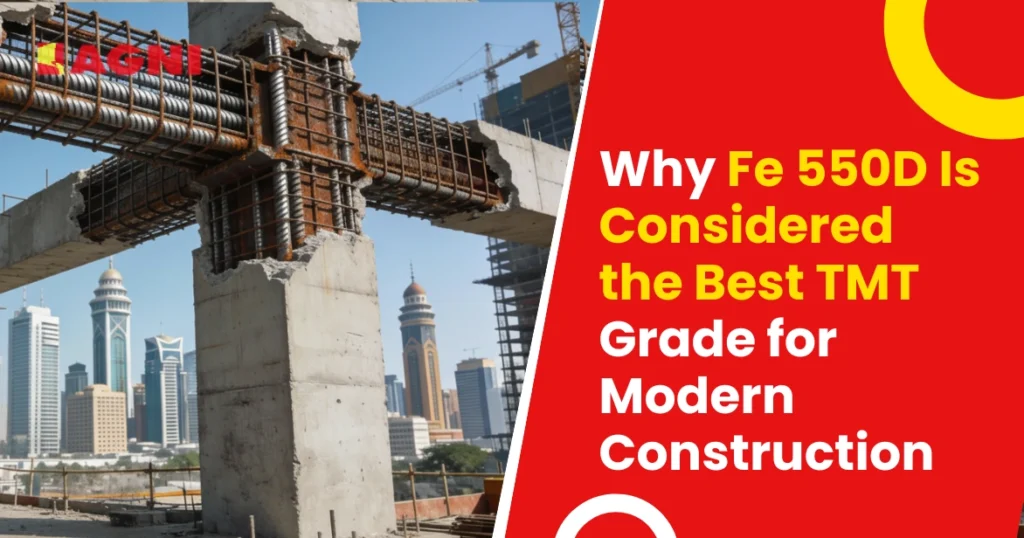
Did you know that, currently, approximately 65% of India’s steel output is used for construction? Therefore, selecting the right TMT grade has a significant impact on the safety and efficiency of modern construction in India. The Fe 550D TMT Bars are ideal for all types of high-rise buildings, including those in seismic zones, due to their superior ductility and strength. Scroll down to explore the specifications of the Fe 550D and know why it is better than other modern construction materials.
What Is Fe 550D? Understanding the Grade & Its Specifications
Fe 550D is a type of iron TMT bar that has a yield strength of at least 550 N/mm². The grade ‘D’ in ‘Fe 550D’ stands for improved ductility according to the IS 1786:2008 standard. Additionally, the TMT bars meet the BIS requirements for chemical composition, which allow for a maximum of 0.25% carbon, 0.040% sulphur, and 0.040% phosphorus.
High-Yield Strength: The Core Advantage of Fe 550D
Fe 550D TMT bars offer 550 N/mm² yield strength, surpassing Fe 500’s 500 N/mm². Fe 550D also has a minimum tensile strength of between 585-600 N/mm², making it suitable for supporting large amounts of weight in modern construction, including buildings such as skyscrapers.
Superior Ductility: Why the ‘D’ in Fe 550D Is Crucial
Fe 550D offers greater ductility than Fe 550, stretching 14.5-16% without breaking, while Fe 550 allows only 10% elongation. The high TMT bar ductility will enable them to absorb seismic energy during an earthquake and is therefore ideal for high-rise structures and earthquake-prone regions of India.
Enhanced Earthquake Resistance for Safe Structures
Fe 550D TMT bars provide additional ductility, helping absorb seismic energy. At maximum load, the steel must elongate by 5% before failure. Essentially, in areas with seismic activity, like Gujarat, TMT bars bend rather than break.
High Load-Bearing Capacity for High-Rise & Large Projects
Fe 550D is designed to handle 10% more load than Fe 500 for tall buildings. By using less steel, the structure’s overall weight is reduced by 12%-15%. Therefore, Fe 550D is widely used for large-scale, heavy-duty projects.
Better Bendability & Flexibility for Complex RCC Designs
Fe 550D has been successfully tested for the mandrel bend test required for sizes 20 mm or less. The rebend test has verified that the bars did not develop any cracks during the ageing process. As a result of the increased ductility of TMT bars such as Fe 550D, complex-shaped details can be created using Reinforced Cement Concrete (RCC) systems.
Corrosion Resistance: Long-Term Protection in Coastal & Humid Areas
The Fe 550D has a maximum sulphur/phosphorus content of 0.040%; this helps prevent rusting. Hence, the structure lasts longer in humid/coastal environments than other bar grades used in the same environments.
Compliance With BIS Standards for Safety & Quality
The mechanical properties of the Fe 550D TMT Bar conform to IS 1786:2008. All certified bars satisfy the specifications for yield strength, tensile strength, and percentage elongation, thereby ensuring the highest quality in all types of materials used in modern construction.
Advantages of Fe 550D Over Fe 500, Fe 500D & Fe 600
The tensile strength of Fe 550D is superior to that of both Fe 500D and Fe 600. Moreover, it offers greater ductility than Fe 500 & Fe 600, with a yield strength that exceeds those of all three grades (Fe 550D=550N/mm², Fe 500D=500N/mm², Fe 600=600N/mm²) and elongation (Fe 550D=16%, Fe 500=12%). Additionally, Fe 550D provides optimal performance under seismic loads compared to other TMT grades.
Applications of Fe 550D in Modern Construction
- Residential Properties- Higher TMT bar ductility to build safe multi-storey homes
- Commercial Structures- Higher load capacity for malls
- High-rise Towers- Strength reduces steel by 15%
- Bridges and Flyovers -Better bendability in spans
- Industrial Projects- Corrosion Resistance
Why Do Architects & Engineers Prefer Fe 550D Today?
Architects prefer working with Fe 550D for its ability to meet both seismic regulations and flexibility at an economical price point. The increased strength of Fe 550D reduces the amount of steel required by approximately 15-20%, thus resulting in lower crane loads, reduced labour costs, and more long-term savings. Additionally, the use of Fe 550D enables the construction of multi-storey buildings in earthquake-prone regions and provides corrosion resistance when used in coastal areas.
The combination of these applications has fuelled rapid growth in demand for TMT bars, which is expected to exceed 50 million tonnes per year in India. Furthermore, the TMT bars’ ductility enables designers and builders to create innovative, long-lasting structures.
Final Thoughts
Fe 550D TMT bars are leading among modern construction materials in India, with an unmatched strength-ductility balance. If you are an architect or looking to select a quality construction material for your residential or industrial project, look no further than Fe 550D TMT bars. It’s perfect for India’s seismic, high-rise needs.
