
Understanding the Production Process of TMT Bars
Thermo-mechanically treated (TMT) bars play a crucial role in the construction industry because of their superior strength, ductility, and ability to reinforce concrete structures effectively. The production of TMT bars involves a sophisticated process that enhances the mechanical properties of steel, making it ideal for ensuring the durability and safety of buildings and infrastructure projects. Let’s delve into the detailed production process, highlighting the key stages and the impact of thermo-mechanical treatment (TMT).
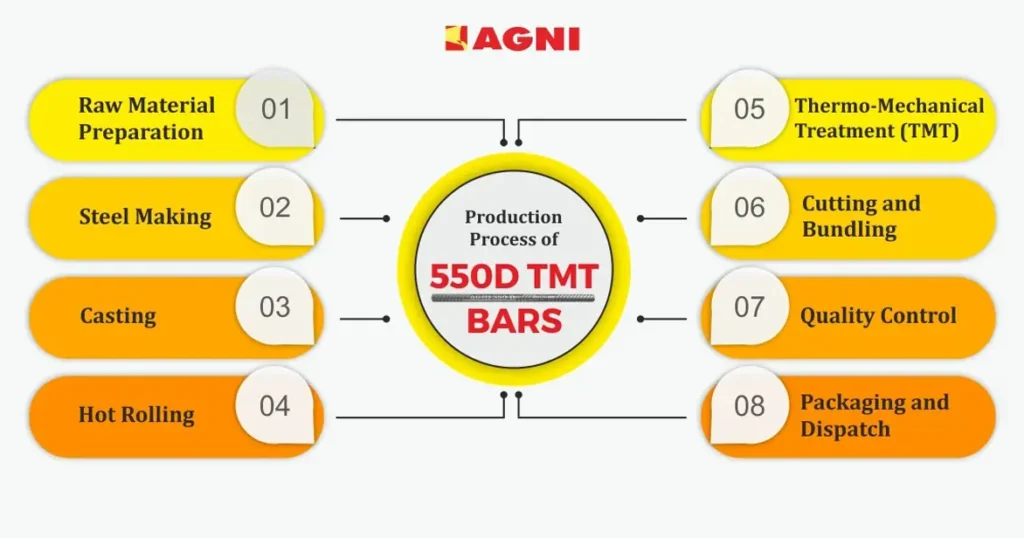
1. Raw Material Preparation
The journey of TMT bars begins with meticulous raw material preparation. High-quality iron ore and scrap metal are sourced and subjected to rigorous processing to remove impurities and achieve the desired chemical composition. This stage is crucial as it lays the foundation for producing consistent quality steel and optimal mechanical properties.
2. Steel Making
Once prepared, the raw materials undergo the steel-making process. In a high-temperature furnace, the materials are melted and refined to achieve the desired chemical composition. Alloying elements such as manganese, chromium, and vanadium are added in precise quantities to impart specific properties to the steel. This phase ensures that the steel meets stringent standards for strength, ductility, and weldability.
3. Continuous Casting
Following steel making, the molten steel is cast into billets through a continuous casting process. This method allows for the production of uniform and defect-free billets of various sizes and lengths. The billets serve as the starting point for the subsequent rolling process, where they are transformed into TMT bars.
4. Hot Rolling
The heart of TMT bar production lies in the hot rolling mill. Here, the steel billets are heated to temperatures ranging from 1100°C to 1200°C and passed through a series of rolling stands. These stands progressively reduce the cross-sectional area of the billets and shape them into long, slender bars of specific diameters. The hot rolling process not only shapes the bars but also initiates grain refinement in the steel structure, preparing it for the next critical phase – thermo-mechanical treatment.
5. Thermo-Mechanical Treatment (TMT)
The distinguishing feature of TMT bars is the thermo-mechanical treatment they undergo immediately after hot rolling. This treatment involves a carefully controlled cooling process designed to optimise the mechanical properties of the bars:
- Quenching: After hot rolling, the bars are rapidly and uniformly cooled on a water-cooling bed. This rapid cooling process induces a transformation in the microstructure of the steel.
- Formation of Martensite: During quenching, the outer surface of the TMT bar transforms into a tough and resilient structure known as tempered martensite. This hardened surface layer provides excellent tensile strength and resistance to deformation, crucial for withstanding dynamic loads in construction applications.
- Core Softening: Simultaneously, the core of the TMT bar remains in a softer, more ductile state. This balanced microstructure enhances the overall ductility and weldability of the bars, allowing them to bend without breaking and facilitating ease of construction.
Impact on Mechanical Properties
The thermo-mechanical treatment significantly enhances the mechanical properties of TMT bars:
- High Yield Stress and Tensile Strength: Agni TMT bars, such as FE 550 D, CRS 550 D, and EQRS 550 D, consistently exceed industry standards for yield stress and tensile strength. These properties ensure structural reliability and resilience under varying environmental and load conditions.
- Superior Elongation: With elongation values ranging from 17% to 19%, Agni TMT bars demonstrate superior ductility compared to conventional bars. This characteristic allows for flexibility in construction, accommodating structural movements and seismic forces without compromising integrity.
Quality Control and Assurance
Throughout the production process, stringent quality control measures are implemented to maintain the highest standards:
- Chemical Properties: Agni TMT bars adhere to strict limits for carbon, manganese, sulphur, phosphorus, and other elements. These controls ensure optimal weldability, corrosion resistance, and durability in diverse environmental conditions.
- Mechanical Testing: Bars undergo comprehensive mechanical testing, including dimensional inspections, surface defect examinations, tensile tests, and bend tests. These tests validate the bars’ adherence to specified standards and their suitability for critical construction applications.
Sustainability and Environmental Responsibility in TMT Bar Production
Modern construction practices increasingly prioritise sustainability, and the steel industry plays a major role in driving environmentally responsible development. Agni Steels has integrated several eco-friendly measures into its production of TMT bars, ensuring that high structural performance does not come at the cost of environmental impact.
1. Energy-Efficient Production Systems
Agni’s rolling mills and steel-making facilities are designed to minimise energy consumption through automated controls and optimised heating processes. These systems reduce carbon emissions while ensuring consistent quality throughout every batch of TMT bars.
2. Reduced Waste Through Continuous Casting
The continuous casting process minimises material wastage and enhances billet purity. By reducing scrap generation and reprocessing needs, Agni Steels contributes to a more sustainable steel manufacturing cycle.
3. Recyclable Steel for Environment-Friendly Construction
All TMT bars produced by Agni Steels are 100% recyclable, making them a sustainable choice for long-term infrastructure development. Their long lifespan and corrosion-resistant properties reduce the need for frequent reconstruction, conserving natural resources.
4. Water Conservation During Quenching
The quenching process, essential for forming the martensitic outer core, is optimised to reuse water through closed-loop systems. This significantly lowers the water footprint during TMT production.
5. Low Carbon Content for Cleaner Steel
Agni TMT bars are engineered with a controlled low-carbon composition, which not only increases weldability and strength but also contributes to reduced carbon emissions during manufacturing.
Why Understanding the Production Process Matters for Buyers
Whether you’re a builder, engineer, contractor, or homeowner, knowing how TMT bars are produced helps you make informed choices. The production process directly influences:
Strength and safety of the structure
Performance during earthquakes and high stresses
Resistance to corrosion and extreme weather
Long-term durability and maintenance cost
Agni Steels’ transparent production practices empower customers to trust the material that goes into their buildings.
Choosing Agni TMT Bars: A Value-Driven Decision
Beyond manufacturing excellence, Agni Steels offers several advantages that make it a preferred choice among leading builders and construction professionals:
1. Special Length Bars for Reduced Wastage
Agni offers special length TMT bars that minimise cutting loss, reduce labour time, and improve project efficiency.
2. Wide Dealer & Supplier Network
With one of the strongest dealer networks in South India, Agni ensures the timely availability of TMT bars across regions for projects of all scales.
3. Consistent Quality Backed by Certifications
Agni TMT bars come with ISI certification and follow strict BIS-compliant manufacturing processes. This ensures every bar performs consistently, backed by industry benchmarks.
4. Trusted by Major Infrastructure Developers
From housing projects to large-scale infrastructure, Agni Steels is recognised as a reliable partner for delivering steel that meets the highest structural standards.
Conclusion
Understanding the intricate production process of TMT bars, particularly the thermo-mechanical treatment stage, underscores their critical role in modern construction practices. Agni TMT bars exemplify the fusion of advanced metallurgical techniques and engineering precision, setting benchmarks for durability, safety, and sustainability in infrastructure development worldwide.
By leveraging the benefits of thermo-mechanical treatment, Agni TMT bars continue to advance the resilience and longevity of buildings, bridges, and other essential structures. For construction professionals and engineers, Agni Steels offers a range of high-performance TMT bars designed to meet the most demanding project requirements and ensure enduring structural integrity.
Discover why we are among the Top 10 Best TMT Bar Manufacturers, delivering ISI TMT Bars and Special Length TMT Bars trusted by leading Steel Majors and Steel Manufacturers. Explore our range of Super Strong TMT Bars and find out the TMT Bar Price Today for your next project. Join our list of TMT Bars Suppliers and discover the Top 550D TMT Bars for Construction with Agni TMT Steel.