
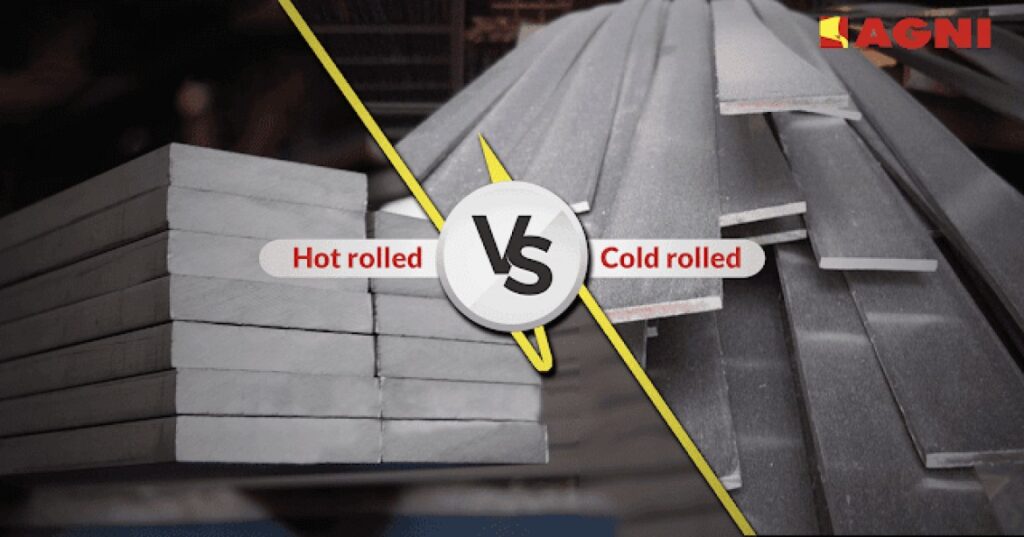
The process of rolling steel in a manufacturing plant is well researched and planned according to the desired results. When you are choosing the raw materials for your constructions, it is important to understand such properties to ensure you are not wasting your resources on the wrong materials and choose the most suitable materials for your project. There are two major types of steel processing of Steel, Hot rolled and Cold rolled. Whether the steel was hot rolled or cold rolled for its production will affect the core physical and chemical properties and, therefore, is a key factor that decides the applications of the products.
Cold Rolled Steel:
Cold rolling is the process in which steel is rolled at room temperature, below the re-crystallisation temperature.
- The processing takes a long time and a lot of pressure is needed as it is not supplied with heat, which helps in fastening the process.
- The products formed through Cold Rolling have smoother surfaces as compared to their Hot-rolled counterparts.
- In this rolling process, there is no melting involved, which gives the product its characteristic sharp square edges.
- Cold Rolling makes the product less malleable, restricting the number of shapes the product can take.
- The most common applications of cold-rolled steel can be seen as Flat Steel in automotive parts, in machines and for industries that are inclined towards more aesthetic value than other physical properties.
Hot Rolled Steel:
Hot rolling is the process in which steel is rolled at very high temperatures, above recrystallisation temperature.
- The processing is fast-paced as the high temperatures allow the product to be formed faster, saving costs and production time.
- The products formed through Hot Rolling have rough, scaly surfaces that are ideal for their applications in machining and metal work.
- The cooling process after the hot rolling ensures zero-stress as it does not include quenching and work-hardening processes.
- Hot rolling makes the product extremely malleable; there is a range of shapes and sizes possible for the products.
- The most common applications of hot rolled steel can be seen as machining for auto parts, manufacturing and also for the building and construction industry, such as l-beams, steel bars, etc.
This knowledge will give you the right direction when you are choosing the steel for your specific application purposes. Choosing the right steel for your application will not only save you time and investments but also ensure that your application is durable and reliable.
At Agni Steels, we use the hot rolling process at our manufacturing plant to produce our signature TMT Steel Rods used by the construction industry.
Key Differences Between Hot Rolled and Cold Rolled Steel
Understanding the differences at a glance helps engineers, builders, and homeowners make faster decisions.
| Aspect | Hot Rolled Steel | Cold Rolled Steel |
|---|---|---|
| Processing Temperature | Above recrystallization | Room temperature |
| Surface Finish | Rough, scaly | Smooth, polished |
| Strength & Ductility | High ductility | Higher tensile strength |
| Shape Flexibility | Wide range of shapes | Limited shapes |
| Cost | More economical | More expensive |
| Best Use | Construction & infrastructure | Automotive & appliances |
Why Hot Rolled Steel Is Preferred in Construction
For structural and load-bearing applications, hot-rolled steel is the industry standard due to its superior workability and durability.
-
Handles heavy loads efficiently
-
Performs well under stress and pressure
-
Ideal for beams, columns, rebars, and rods
-
Cost-effective for large-scale projects
-
Easy to weld, cut, and fabricate on-site
This makes hot-rolled steel the backbone of residential, commercial, and infrastructure development.
Impact of Rolling Process on Steel Strength
The rolling method directly affects the mechanical properties of steel:
-
Hot rolling improves grain structure and reduces internal stresses, ensuring long-term structural stability.
-
Cold rolling increases hardness and surface finish but reduces flexibility, which limits its structural use.
For earthquake-resistant and load-bearing structures, hot-rolled steel provides better performance and safety margins.
Choosing the Right Steel for Your Project
Before selecting steel, consider the following factors:
-
Nature of the project (structural or aesthetic)
-
Load-bearing requirements
-
Environmental exposure
-
Budget constraints
-
Fabrication and installation needs
If strength, durability, and safety are your priorities, hot-rolled steel is the right choice.
Why Agni Steels Uses Hot Rolling for TMT Bars
At Agni Steels, hot rolling is combined with advanced thermo-mechanical treatment to manufacture high-quality TMT steel rods. This process ensures:
-
High tensile strength
-
Superior ductility
-
Excellent bonding with concrete
-
Enhanced corrosion resistance
-
Compliance with construction standards
These properties make Agni Steels TMT bars a trusted choice for durable and reliable construction.
Final Thoughts
Understanding the difference between hot-rolled and cold-rolled steel helps avoid costly mistakes and ensures optimal performance. The right choice of steel directly impacts the safety, longevity, and cost-efficiency of your project.
For construction that stands strong for generations, hot-rolled steel—especially high-quality TMT bars—remains the preferred solution.
