
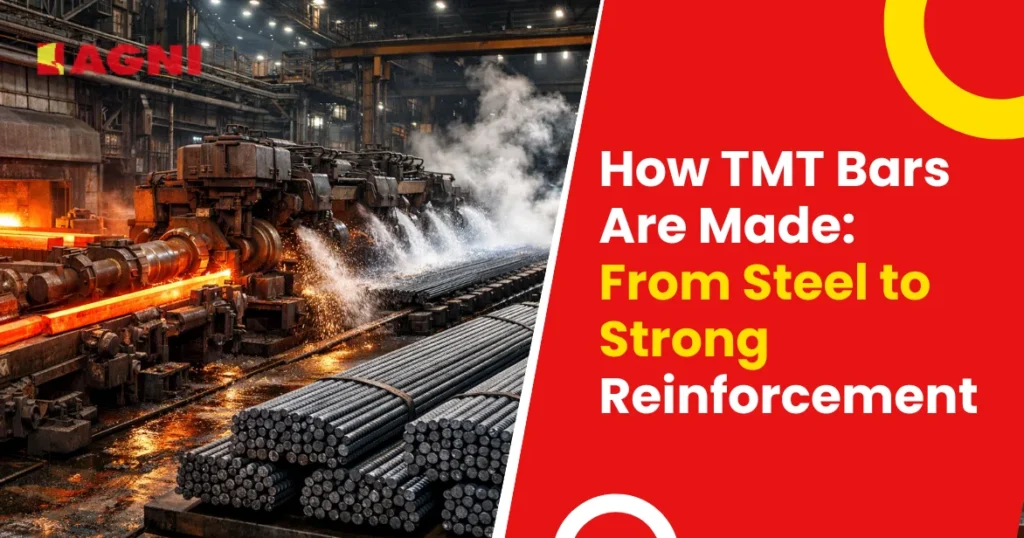
TMT bars are very important in modern construction because of their durability, flexibility and load-bearing capabilities in buildings, bridges and infrastructure projects. The manufacturing process of the bars is very important, as it determines their mechanical properties, including their strength, ductility and TMT bars corrosion resistance.
In this blog, we take you through the entire process of making TMT bars, starting from raw steel to finished reinforcement bars.
What Are TMT Bars?
TMT bars are steel bars that are thermo-mechanically treated and have been extensively used in reinforced concrete structures. They are characterised by high tensile strength, high ductility and good bonding with concrete.
These bars undergo a special heat treatment process, which improves the structural performance of the bars while making sure they remain flexible.
Raw Materials Used in TMT Bar Manufacturing
The main input consists of billets made of high-grade steel. These billets are normally composed of iron ore, sponge iron, and scrap steel, which are treated in controlled conditions to ensure chemical consistency.
Carbon, sulphur and phosphorus have to be used in the right amount to ensure strength and corrosion resistance.
Step 1: Steel Billet Preparation
The manufacturing process begins with steel billets, which are blocks of steel shaped either rectangular or square.
These billets are checked for surface flaws, size uniformity and chemical composition.
Step 2: Heating in the Reheating Furnace
After passing through the approval process, the steel billets are put into a reheating furnace where they are heated to approximately 1100-1200°C.
This heating causes the steel to become malleable and easy to roll.
Step 3: Hot Rolling Process
The billets are then heated and subjected to a series of rolling mills. During this hot rolling, the billets are gradually reduced in size and shaped into long steel bars with ribbed surfaces.
These ribs help improve the bonding between the bar and concrete. The grain structure of the steel also gets refined in the rolling process, which helps improve its mechanical properties.
Step 4: Thermo-Mechanical Treatment (TMT Process)
The bars are hot rolled, immediately after which they undergo a thermomechanical treatment process.
After this, the bars are subjected to rapid cooling with high-pressure jets of water.
Step 5: Quenching and Self-Tempering
During quenching, the outer layer of the bar transforms into a hard martensitic structure. With the bar moving out of the cooling zone, the heat from the core flows outward, resulting in the outer layer self-tempering.
This gives it a distinctive design where the exterior is hard and strong, while the core remains soft and flexible.
Step 6: Atmospheric Cooling and Microstructure Formation
The bars are left to cool naturally after self-tempering. In this stage, the core develops a fine-grained ferrite-pearlite structure.
It is this microstructure that gives it high elongation, bendability, and TMT bars’ corrosion resistance, making them suitable for use in coastal and high-humidity environments.
Step 7: Cutting, Bundling, and Marking
After cooling, the bars are cut into standard lengths, which are typically 6 metres or 12 metres. They are then bundled and securely tied for transportation.
Every bundle is labelled with details about the bar diameter, grade, batch number, and the manufacturer identification to ensure traceability and quality assurance.
Quality Testing and ISI/BIS Standards
Quality testing is a crucial aspect of ISI-certified TMT bar manufacturing. The bars are also subjected to stringent tests to make sure they meet BIS standards.
The bars that are available in the market are only those that have passed the necessary standard tests, hence ensuring safety and reliability in construction work.
Why the Manufacturing Process Matters for Strength
The controlled manufacturing performance directly influences the performance of TMT bars in real-world conditions.
Proper heat treatment and formation of microstructure make sure that the bars can absorb stress, resist cracking, and maintain structural integrity during earthquakes or heavy loading.
Applications of TMT Bars in Construction
- Commercial and residential structures
- Bridges and flyovers
- Dams and power plants
- Industrial structures
- Infrastructure projects like metros and highways
From Steel to Strong Reinforcement
The journey from raw steel to finished TMT bars is a carefully controlled process that combines advanced technology, precise heat treatment and strict quality standards.
By choosing ISI-certified TMT bars manufacturing companies, builders can ensure structural safety, durability, and peace of mind.